
The Bondi Beach terror attack brought Australia to a halt – and simultaneously pushed newsrooms into overdrive, rushing to report the latest updates on the country’s deadliest mass shooting since the 1996 Port Arthur massacre.
Journalists navigated a deluge of grief, fear and outrage to report to a community desperate for answers.
Overall, Australian news media “performed very well” Denis Muller, senior research fellow at the University of Melbourne’s Centre for Advancing Journalism, told PIJI.
He knows firsthand the difficulty of the job journalists are tasked with after these deadly events; Muller was an editor at The Age at the time of the 1987 Hoddle Street massacre, which left seven people dead and 19 injured.
He emphasised the ‘danger’ of making judgements with the “benefit of hindsight” on the performance of news media during the direct aftermath of major events.
“In the early hours of these events, you really don’t know what’s happened and you can only do the best you can with what you know at the time,” he said.
“It’s terribly difficult to make sense of what’s going on and to even judge how big the story might be.
“I’m very reluctant to criticise the news judgments that were made, especially on the Sunday night and on the Monday, because at that time, our information is terribly incomplete and on the whole, they did a really good job.”
He said the geographic and cultural proximity of the attack heightened the risk of Australian news media unintentionally causing harm by rushing coverage without fully thinking through public and personal ramifications.
Muller said some publishers left footage of police confronting the gunmen up “a day too long”, opening themselves up to “accusations of exploiting violence for commercial gain”.
He said questions about what ASIO knew and did about the alleged shooters and the government’s response to antisemitism – which were posed by the media in the first day after the attack – were “legitimate”.
But it is important to consider when it is “decent” to start asking those questions without adding to the grief of victims’ families by making them feel like “yesterday’s news”, he said.
Muller also cautioned the use of social media as a resource must be balanced with journalists’ responsibility to ensure what is published is verifiably true.
“Bad actors are on the job just as quickly as legitimate journalists are on the job,” he said.
“So journalists need to be absolutely sure that when they’re taking advantage of the eyewitness images, in particular, they are what they purport to be.”
Sorting truth from lies
Fact checkers were kept busy after the Bondi attack as multiple false claims and edited or AI-generated images spread quickly online and incited discord.
In the first week after the shooting, these ranged from innocent men misidentified as the alleged shooters to a video falsely showing the NSW premier sharing then-unconfirmed details about the event.
ABC News Verify acting lead Matt Martino told PIJI people began attempting to shape the narrative around the attack to suit their own agendas as soon as the morning after the shooting.
“It is quite hazy when such a traumatic and horrific event occurs,” he said.
“People are really thirsty for good information, and misinformation often fills the void.
“That’s why teams like ours exist: to set the record straight and tell people exactly what they can trust.”
From AI-generated deepfake content to “cheapfakes” – which Martino describes as content edited without AI, selectively cropped or simply placed out of context with misleading information – there were several false stories to debunk after the Bondi attack.
At the time of writing, many cases were relatively simple to resolve.
In one example, the heroic actions of Syrian immigrant Ahmed al Ahmed, who disarmed one the gunmen, were falsely attributed to ‘Edward Crabtree’, while other online posts claimed al Ahmed was not Middle Eastern – falsehoods soon cleared up by his parents and authorities.
In a widely-spread cheapfake, a picture of a female NSW police officer with her hands up was cropped and presented out of context in posts which claimed she had ‘frozen’ during the shooting, drawing sexist comments. In the full image, the officer was shown to be urging members of the public to move out of harm’s way.
A further two images circulated online – one purportedly showing a victim having his face painted as part of ‘Mossad propaganda’ and another appearing to show one of the alleged gunman in the Philippines – were proved to be made using Google AI tools.
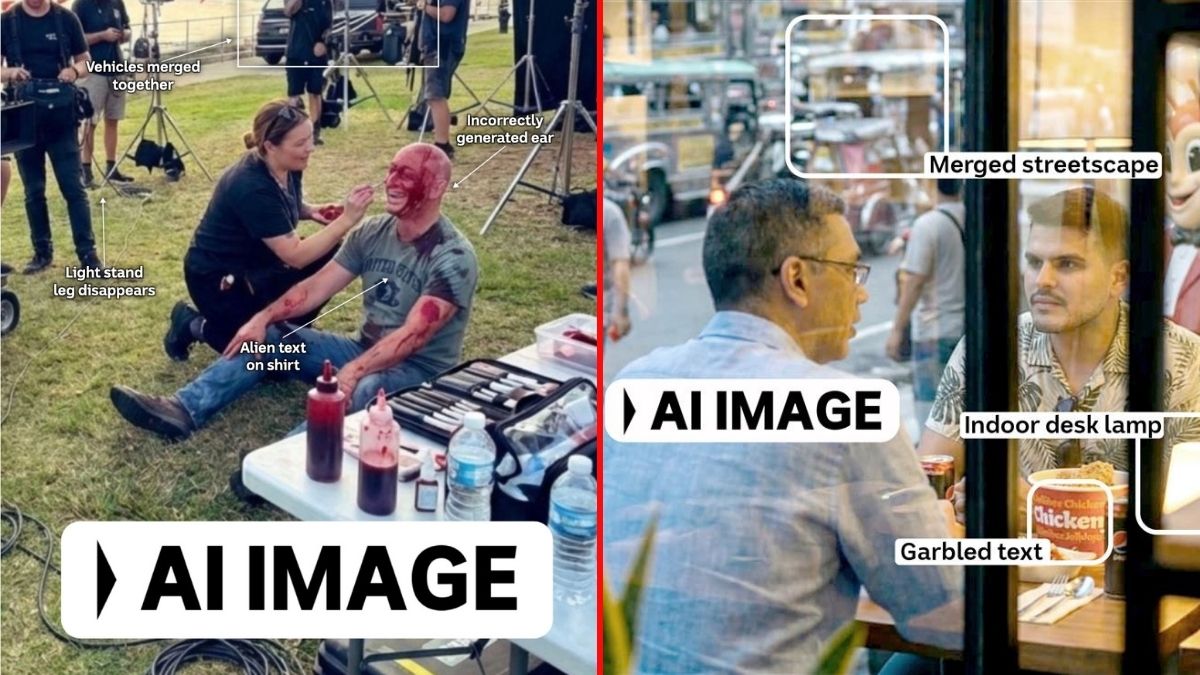
Martino said his team got “lucky” when they put the images through Google’s SynthID Detector, which identified the invisible digital watermark embedded in content developed by Google DeepMind.
Content generated by other AI tools do not offer the same identifying feature, and the people that create such content can be “very difficult” to track down.
“What’s important is to remember that perhaps the source doesn’t matter as much as the agenda that it’s pursuing,” Martino said.
“If you see a Jewish survivor being painted as a crisis actor, that’s clearly an attempt from someone who has an antisemitic agenda to try and downplay the horrific events as they occurred.”
Apart from digital watermarks, other features he looks for to identify fake or edited images include inconsistencies with verified photos or videos of the same event or person; poor rendering; objects that look out of place; and location misalignment confirmed with tools such as Google Street View or other verified vision.
“There’s a temptation with some of the images and the videos to just go, ‘Oh, well, that looks like Bondi, so let’s just whack it up.’
“But the reality is that AI has introduced a complex vector to the misinformation landscape, and so those extra checks we need to do just to make sure that everything’s lining up.”
“[ABC News Verify is] always showing our work … We want to make sure that people can reverse-engineer what we’ve done. That’s the way we build trust.”
Written by Sezen Bakan