
Australia’s two public broadcasters have been ordered not to destroy any records that may be needed to inform the Royal Commission on Antisemitism and Social Cohesion, raising concerns over the protection of confidential sources.
The National Archives of Australia (NAA) issued a ‘notice of disposal freeze’ last month to several government departments and agencies, including the ABC and the SBS.
An MEAA spokesperson told Crikey its members at the public broadcasters are “worried about the implications for their ability to protect sources and uphold critical pillars of press freedom”.
There should not be a blanket exemption for news media from disposal freezes, particularly on matters of public interest, Denis Muller, senior research fellow at the University of Melbourne Centre for Advancing Journalism, told PIJI.
But he said there also cannot be “open slather” for royal commission staff to examine documents that might disclose the identity of a confidential source.
“There needs to be a negotiated solution,” Muller said.
“I think it’s reasonable to say to the royal commission, ‘We want to redact material that would tend to identify confidential sources … in ways that won’t impede the royal commission’s proceedings.’
“‘So, we’d be prepared to do it in consultation, but we do have an overriding ethical obligation to protect the identity of confidential sources.’”
There have not yet been any orders to turn over records to the royal commission, and University of Melbourne Law School associate professor Jason Bosland pointed out it may be a “non-issue” if no confidential sources exist in relation to the relevant subjects.
Under the Evidence Act 1995, journalists cannot be forced to answer questions or produce documents that would identify their confidential source, unless the court finds that public interest outweighs certain adverse consequences of the disclosure.
But Bosland said the ‘shield’ provided by the Act would likely not apply to a royal commission.
If a royal commission orders documents to be produced, it is a criminal offence not to comply without a ‘reasonable excuse’. Non-compliance is punishable by imprisonment or a fine.
“There’s no common law protection for journalists,” Bosland said.
“A journalist will be in contempt if they refuse to hand over materials or to answer questions, and I suppose it will be up to the individual journalists to decide whether or not they’re willing to do that.”
A National Archives spokesperson referred PIJI to the ABC, the SBS and the royal commission when questioned as to whether there would be any allowances made for the protection of confidential sources if journalists were asked to submit materials to the royal commission.
What is the disposal freeze?
The disposal freeze issued last month means records relevant to the remit of the Royal Commission on Antisemitism and Social Cohesion cannot be destroyed, including but not limited to, emails, texts, social media posts and instant messages on work and personal devices.
The range of subjects listed under the disposal freeze is also broad.
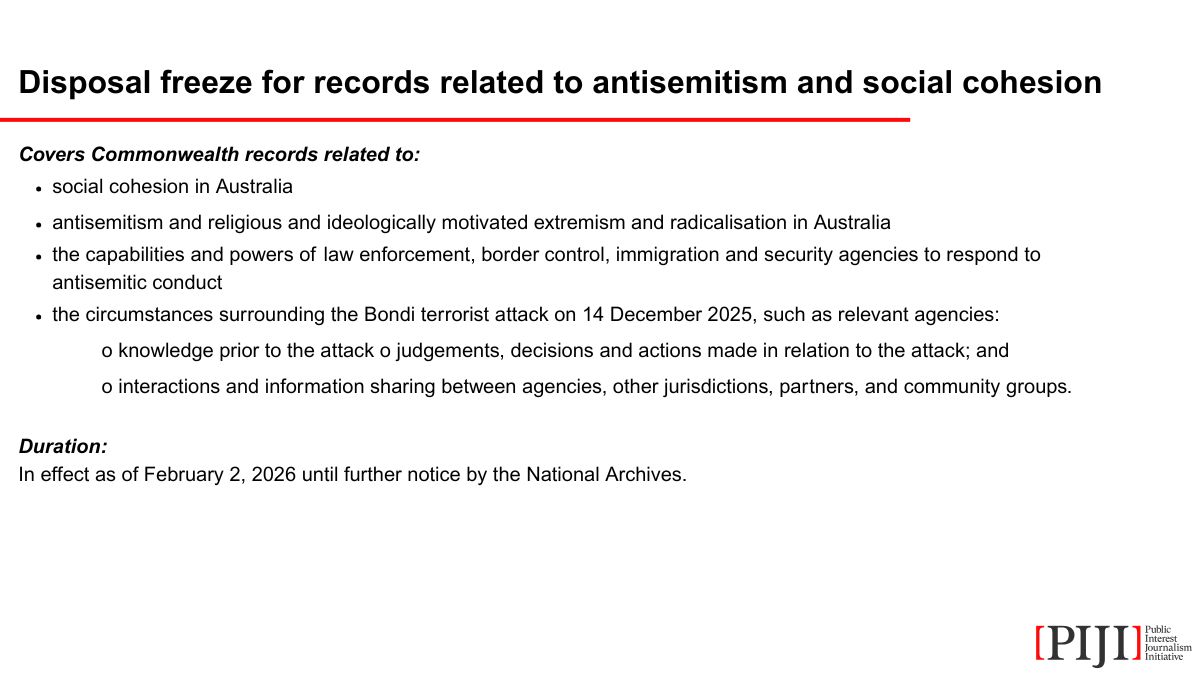 The move is not unprecedented; other disposal freezes currently in force relate to issues such as the Robodebt scheme and the Afghanistan inquiry.
Broadcasters’ response
An SBS spokesperson told PIJI the broadcaster is complying with its record management obligations under the notice of disposal freeze.
“We also have responsibilities to maintain the confidentiality of editorial sources where such an undertaking has been given,” the SBS spokesperson said.
“Should any issues arise with requests for documents, we will navigate them on a case-by-case basis.”
When questioned in Senate estimates, ABC editorial director Gavin Fang indicated the ABC would likewise deal with the protection of journalists and sources on a “case-by-case basis” in the event of royal commission production orders.
In a memo informing news staff of the notice of disposal freeze, as reported by Crikey, ABC news director Justin Stevens stated the use of disappearing messages on apps such as Signal would be a breach of the notice. Disappearing messages in apps like Signal are used by journalists to communicate with sources confidentially.
A section of a memo from Stevens made available to PIJI stated that should the royal commission request materials that could compromise confidential source commitments, the ABC would “take advice from ABC Legal to ensure we comply with any order while protecting any sources.”
“This is a useful reminder for us all that properly protecting sources should always be a primary consideration for all journalists throughout the newsgathering process – not just when we receive notices such as this, after the fact,” the memo stated.
“There are not strong enough laws in place to ensure journalists have adequate source protections, including no uniform shield laws.
“When you are creating records or communications you should always consider that they may potentially compromise the confidentiality of any sources. We already navigate the complexity of this reality every day.”
Sezen Bakan